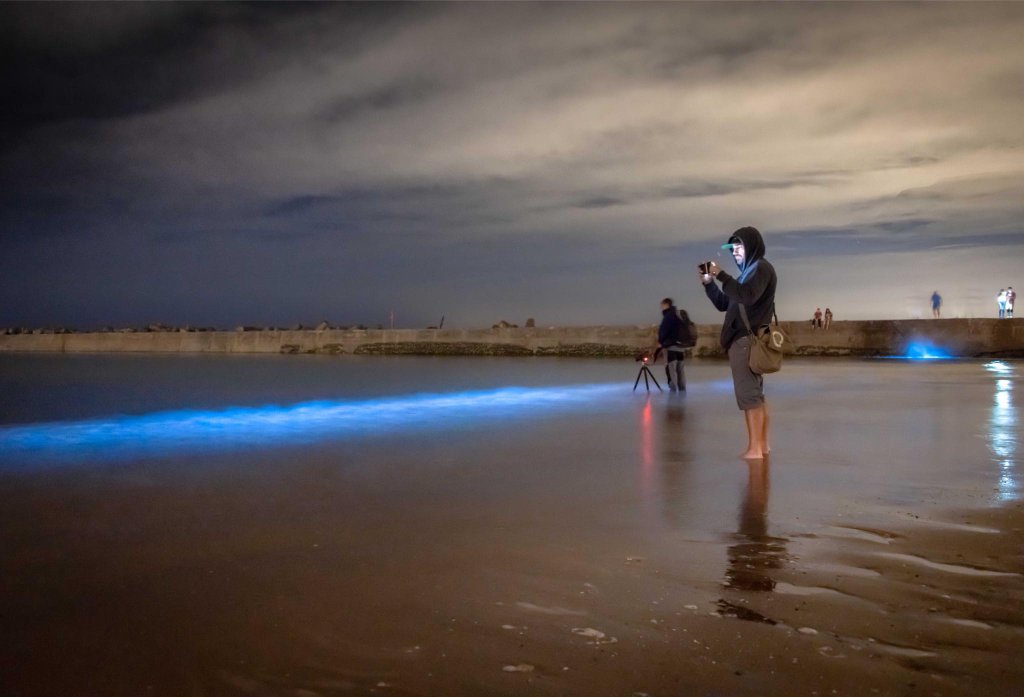
Photo © Georgina Harper
Welcome to SeaSparkle
SeaSparkle is a free citizen science project helping people discover, record and better understand coastal bioluminescence across the UK and Ireland.
Whether you witness an incredible glowing shoreline or simply head out and don't see anything, every report helps improve our understanding of when and where bioluminescence occurs.
Explore the map
The map is the heart of SeaSparkle.
Move around the coastline and tap anywhere to explore local conditions.
You can:
- View recent community sightings.
- See where people looked but didn't observe any glow ("No Shows").
- Explore satellite-derived bloom conditions.
- View ocean currents and environmental data.
- Replay previous days, weeks and seasons to see what actually happened.
The map is continually updated as new reports and environmental data become available.
Record your observations
Every observation matters.
You can record:
- ✨ Sighting – You observed bioluminescence.
- 🌑 No Show – You visited a location but didn't see any glow.
- 📷 Historic sightings – If you've experienced bioluminescence before, you can add previous observations too. The date can often be recovered from your photo's metadata (EXIF information).
Historic reports are just as valuable as new ones and help us build a long-term record stretching back many years.
Glow Chance
Glow Chance is SeaSparkle's experimental forecasting system.
Rather than simply looking at one piece of information, Glow Chance combines a range of environmental conditions including:
- Satellite-observed phytoplankton blooms
- Sea surface temperature
- Ocean currents
- Tides
- Wind and weather
- Recent community sightings
- Historic observations
- Beach characteristics
The result is an estimate of how favourable conditions may be for observing coastal bioluminescence.
Glow Chance is continually improving as more community observations are added.
Replay
Replay allows you to travel back through previous nights, weeks and seasons.
Compare Glow Chance with what actually happened, explore past bloom events and discover how changing environmental conditions influenced observations.
Every new report helps improve future predictions.
Why report "No Shows"?
Knowing where people didn't observe bioluminescence is just as important as knowing where they did.
"No Show" reports help us understand when conditions were unsuitable and improve future forecasts.
Citizen Science
SeaSparkle exists because of its community.
Every report contributes to one of the largest community datasets on coastal bioluminescence in the UK and Ireland.
Our aim is to support future scientific research while helping more people experience one of nature's most spectacular phenomena.
Stay Safe
Always put safety first.
- Never enter the sea at night.
- Be aware of tides and changing weather.
- Tell someone where you're going.
- Carry a torch and appropriate clothing.
- In an emergency, call 999 and ask for the Coastguard.